Monday, March 26, 2007


Any discomfort from the scorching midday sun was pushed to the back of my mind thanks to the breathtaking beauty of the tropical islands that drifted by as we sliced through the vibrantly blue Caribbean waters off the coast of the province of Bocas del Toro, Panama. During the 3-hour boat ride from Isla Colon to the small indigenous town of Rio Cañas, all I could think of was what may lie beneath the glassy water’s surface: corals, colorful tropical fish, sea turtles?

From March 16-19, four Peace Corps Panama Volunteers and their three community counterparts had the opportunity to accompany Cristina Ordonez from the Caribbean Conservation Corporation (CCC) to Rio Cañas, where she led a hands-on sea turtle conservation seminar. The attendees arrived from various sites on the Pacific coast of Panama, ranging from Isla Cañas in Los Santos, to Puerto Pedregal in Chiriquì. The purpose of the seminar was to train the volunteers and their counterparts in appropriate conservation techniques regarding sea turtle conservation projects. All of the attendees work directly with sea turtle conservation projects in their communities. Upon return to their communities, the volunteers and their counterparts will train other community members involved in sea turtle conservation efforts.

Ordonez, in cooperation with the CCC based out of Gainesville, Florida, has been working in the Ngöbe-Bugle town of Rio Cañas for the past 9 years. There, she conducts night patrols of the 24-km beach in order to analyze the genetics, nesting, and migratory patterns of the three species of sea turtles that nest on the Caribbean coast of Panama: the Leatherback (Dermochelys coriacea), Green turtle (Chelonya midas), and Hawksbill (Eretmochelys imbricata), all of which are in danger of extinction. Over the past 9 years, through educational programs, she has transformed the community into a group of conservationists with a passion for saving the species that frequent the beaches. There are now many community members who help patrol the large beach and collect scientific data that contribute to the conservation project. This is an ideal example of community-based conservation, one that the Peace Corps Volunteers hope to follow in order to set up similar sustainable conservation programs in their communities around the country.

In addition to educating the community members of Rio Cañas about sea turtle conservation, Ordonez and the CCC offer seminars for university students and other volunteers interested in conserving the species. During the 3-day seminar in March, the Peace Corps Volunteers and counterparts received lectures about sea turtle biology, conservation, education techniques, and ecotourism projects. In addition, the attendees were invited on the nightly beach patrols, where important data such as measurements of the animals, number of eggs, and location of nests, are noted for future analysis. March is the first of five months of nesting for the Leatherback sea turtle, the largest of the eight species of sea turtles in the world, on the Caribbean coast of Panama. During two nights of patrols, the attendees took data on eight adult female Leatherbacks who were in the process of laying their eggs on the beach. In the morning, an inventory of the total number of nests was taken. During this time period, about 15 Leatherback sea turtles were arriving to the beach every night to lay their eggs, the largest measuring over five feet long.

The sight of the large, primordial creatures placing their glossy, golf-ball size offerings into the dangerous world was incredible. The mothers breathed heavily, making sounds that one would have expected to hear millions of years ago, during the time of the dinosaurs, an era that the sea turtles have survived. Since only one of 1,000 of the eggs placed into the sand will survive to adulthood, urgent efforts must take place to save the species that are being outrun by their primary predator: the human being. Illegal poaching of the sea turtles and their eggs still takes place, especially in developing countries such as Panama. Increased land and water contamination created by increased population size and economic development also contribute to the decline of the species. Conservation efforts such as those of Ordonez and the Peace Corps Volunteers are crucial in preserving the ecosystems of our world’s oceans.

Tuesday, March 13, 2007


The first annual Feria de la playa Barqueta was a success! The highlight was a traditional performance by a dance group. The group of kids travels around the country to different events, where they perform four distinct traditional Panamanian dances. Also represented at the fair were artisans who made jewelry, woodworking, dolls, clothing and sweets. Hopefully next year the fair will be bigger and better! After all the hard work to plan the fair, it was worth it to have people ask me when the next fair would be. The event attracted about 400 people, many of which would not have otherwise come to the area. With our efforts to plan the fair and other events, we are slowly defining playa Barqueta as a respected tourist destination!

This weekend I'm off to a sea turtle conservation seminar in Bocas del Toro. Then, next week, I'll have the opportunity to take some notes at the International Feria de David. I'm hoping to make a trip to Colon at the end of the month, to see a different part of the country and enjoy the Caribbean before the rainy season sets it and I begin teaching again. The summer here is at its close, and classes started on Monday. The weather is becoming more humid by the day, and I anxiously await the refreshing rains that will come in May!

Saturday, March 03, 2007

If you find yourself in Panama the 11th of March, make sure to stop by my beach, playa la Barqueta, for first annual artisan's fair! It's amazing how fast a seemingly crazy idea can turn into a full-blown project once you put your mind to it. I've been working hard organizing and promoting this fair that will take place next weekend, one of many events that will contribute to ecotourism revenue in the area. Fifteen art vendors from the area will be coming to sell their art, in addition to local food vendors, a folkloric dance group performance, and a discoteca dance for all at night. Many tourists (local and international) arrive to the beach, especially during the dry season. We hope to establish a permanent local market in the future in this site.

Some of the proceeds from the fair will go toward the sea turtle conservation project, specifically the construction of a new sea turtle hatchery that we will be constructing before the next nesting season begins in June. I will be posting a link to a website in the near future, for all those interesting in contributing to the project from home. My community counterpart, Marcial, and I will be travelling to Bocas del Toro this month, where the Caribbean Conservation Corporation (CCC) is holding a training seminar about correct management of sea turtle conservation projects. I am excited to finally see some mature female sea turtles! March is the primary nesting month for the Caribbean Loggerhead sea turtle, and the seminar will take us to one of the main nesting sites in Bocas del Toro.

My Panama Verde youth group is going strong so far, although with the start of classes next week there may be a few changes. The kids are excited about all of the activities so far, which have included an ecotourism lecture and visit to the beach, a community garbage clean-up and today an a jewelry-making lesson from a local artisan. We collected shells and decorative seeds to make into jewelry, possibly selling some art at the fair next weekend. I enjoy working with the youth (this group ages 12-20), and they keep me busy with visits and mini-dance parties in my house.

On Monday I'm off to a partner's conference in the province of Panamá, again taking Marcial away from his first month as a park ranger for ANAM. I look forward to seeing my friends again and taking a little break before the fair next weekend! ¡Que va!

Wednesday, February 14, 2007


Feliz dìa de amor y amistad!

I took myself on a date to Boquete, to enjoy the cool breeze and excellent coffee. Last month, I was here for the Feria de las Flores y el Cafè, where I visited the orchid house and fell in love with the strange and gorgeous flowers, like the variety above.

The new year has escalated into a frenzy of activities. Today is a breath of fresh air, between yesterday's day trip to the beach with my new Panamà Verde group (Jovenes Guardianes de la Naturaleza - Young Nature Guardians), and tomorrow's paseo to another beach, playa Malena, in the province of Veraguas. At playa Malena, a previous Volunteer helped build a sea turtle hatchery that we would like to replicate at my site on Barqueta beach. From there, I will visit a few of my friends in the province of Herrera just in time to get a taste of culture during the famous Carnavales in Las Tablas.

Winter storms?

In the city of David, the average forcasted temperature for the next 10 days hovers around 95 degrees F. The UV Index today is 9 (out of 10). Walking down the dusty, wind-swept streets becomes a game of finding the nearest patch of shade to duck under. In the afternoon when the wind picks up, the sweat flows that freely from every oozing gland is tossed into the air, immediately vaporized. Last night was so miserable that to fall asleep I splayed out on the 1/4" thick yoga mat on my cool, concrete floor, next to the kitty who was also disfrutar-ing the relative freshness of the piso. It's the antithesis of the negative-degree temperatures I used to experience during a Minnesota February. There, any moisture exposed to the air immediately froze (snot, eyeballs, etc.) . Here, the hot air costricts the throat and dessicates the body. Which is why I came to Boquete for a day. Paradise found.

If it wasn't hot enough already, summer is the time for burning. Hundreds of acres of burning sugarcane fields shoot plumes of brownish soot up into the atmosphere 24/7, creating a low cloud of smog that obstructs the view of the mighty (inactive?) Volcàn Baru. When the winds change, the ash descends to coat everything, including lungs, in a fine film of dust (cough, cough). And they're proposing sugarcane ethanol as an alternative "clean" fuel? One of the next Panamà Verde projects will be garbage management, including offering alternatives to burning garbage. For now, I will enjoy the fresh mountain air!

Que tenga un dìa llena de amor y felicidades.

Wednesday, January 24, 2007


I got a kitty. Isn't she cute?? Her name is Fantasma, the Spanish word for "ghost", which really freaks out some people in my town, especially since she has one blue eye and the other grey-green. When she's not scratching up my legs by trying to climb me, she's a great companion and source of entertainment. Plus, it gives the neighbor kids something to do on their daily visits.

As I was popping open a can of kitty-formulated tuna the other day, I got to wondering what exactly was in the tuna that made it especially for gatos y gatitos. (What are they feeding you?) The ingredients list didn't give any clues, and judging by the price it's the same as any ordinary can of tuna. I'm guessing they took all the parts that people don't eat and canned them up to sell to people like me who think that they're feeding their pet a nutritious meal. The kitty seemed to like it.

On the subject of food, the book The Omnivore's Dilemma: a natural history of four meals, by Michael Pollan, provides an in-depth examination into the American psyche of eating. Pollan tracks the elements of four meals back to their agricultural roots, a journey that at times is surprisingly long and complex. Pollan takes the reader to Iowa corn fields, the birth of baby greens in California, a self-sustaining Virginia farm and hunting for wild boar, in order to answer oft-ignored questions. If you are what you eat, do you really know what you're eating and where it came from? How much oil got burned to churn that corn into a ready-to-eat processed delight, shipped to be picked up from your nearest McDonald's? What does organic really mean and is it good enough? Pollan calls America out on it's "national eating disorder" and engages the reader with his witty stories and writing style, leaving no choice but to think harder about the impact our food choices make on the health of ourselves and the environment.

So while you're out doing your latest civic duty at the local Whole Foods, I encourage you to swing by the book store on the way home if you want to know what's really for dinner. If you dare.

Kitty couldn't care less.

Saturday, January 06, 2007

From a cloud forest surrounding Volcan Baru to a sponge garden overtaking a wreck in the Caribbean, 2006 progressed into 2007 not uneventfully. After a brief stop in Panama City, Chan and I made our way across the country, where we met up with friends to celebrate Christmas in Cerro Punta, a mountain town surrounded by lush cloud forests. Christmas dinner was prepared in a dark cabin, sin electricidad, and after a few struggles with gas lanterns and Panamanian-style free-range chicken, our dinner turned out to be quite delicious. The coolness of the area added to the holiday atmosphere.

A five hour hike down the backside of the volcano led us to Boquete, where we enjoyed an excellent coffee tour at Kotowa coffee estates, of course complete with a tasting of their delicious shade-grown coffees. Evidently, the cloud forest in the area provides enough shade for the coffee trees that they fall in the category of shade-grown, although they do not grow directly beneath other shade-providing trees.

Grudgingly, I left the cool mountains and returned to my site in Los Pocitos for a couple of days. We spent an afternoon lounging on the Pacific beach before I put Chan to work making a table and doing other household chores.

A trip back over the mountains brought us to the Caribbean Sea and Bocas del Toro. We enjoyed a wreck dive off the coast of Isla Colón. The wreck was surrounded by a range of colorful sponges and corals, and our guide managed to point out a nurse shark resting under the helm of the sunken ship.

Finally, after two long bus trips we arrived back in Panama City, from which we spent a couple days in the sun on Isla Taboga, snorkeling, swimming and hiking. Although of course too short, I enjoyed showing off the wonderful diversity and beauty of Panama.

Wednesday, December 20, 2006

Rake, rake, rake is what I do in my yard. Clean yards being along the lines of importance of religion and food in my town, I do the minimum amount of work required to maintain a sense of decency in my community. The big mango tree is currently my enemy; I must wait 3-4 months for it to hechar las frutas and then maybe we can call a truce.

Last night, as the sun was setting, shouts from a volleyball game across the street could hardly be discerned over my labored breathing. My chosen weapon was a heavy metal rake, the strategy to move a gigantic, already mouldering pile of lives from its station beside the house to the side of the yard, about 15 feet away. By the time dusk arrived and the volleyballers had long ago wandered home for dinner, I was almost ready to wave the little white flag. When the mosquitos rose from their moist-leaved depths to devour my dirt-covered flesh I gave the pile a final pound and ran for cover.

I must note that all of this was being done while breathing in not only the allergy-inducing leaf and grass dust, but the smoke of the neighbors´ burning leave piles. Oh, it was so tempting...why not strike that match and burn the pile where it stood? I haven't even given the charla on the evils of burning trash/leaves/crops and contamination yet. However, there are the ever-present eyes, and my own integrity to consider. These little moments are when I really feel the responsibility of being a Volunteer.

Friday, December 15, 2006

Recently I've latched onto a few projects worth mentioning. First, for the past 2 months or so, I've been teaching English classes: one for adults, and one for kids, both once a week in the nearby school. English classes are secondary, voluntary projects for Volunteers (although after last week's training seminar I wouldn't be surprised if English is a mandatory activity in the future). I've enjoyed getting to know more community members through the classes, and unlike some other subjects, English is something in which I can claim to be an expert. Most often, the classes are informal and fun.

A recent meeting with my community revealed a few potential projects that I've begun researching and developing.
1. Since classes are out for summer (dry season) vacation as of this week, I am planning on starting a Panama Verde group for adolescents who may otherwise be bored over summer vacation. Kind of like an environmentally-focused scouts group, Panama Verde focuses on environmental projects, self-esteem and health education for adolescents in Panama.
2. Also, since there is no trash pickup in town, I am attempting to either organize a trash pickup service and/or educate about the benefits of recycling and composting. Hopefully this will help diminish the currently large amount of garbage being burned every day.
3. Finally, I'm working on a grant proposal to upgrade the dilapidated turtle hatchery on playa La Barqueta. These projects should keep me busy for the next couple months, starting in January after the holidays!

Feliz Navidad!

Thursday, December 07, 2006


After a few days of refresher training courses, I am fried. The brain is working at the rate of a Panamanian sales clerk. The tech classes and advice from current Volunteers were inspiring, the Spanish lessons needed and the ocean swims refreshing. However, this is the first time our training group had been all together since July. Being isolated from all other Volunteers the majority of the time causes us to go on a bit of a social binge when we finally do get together. There was a lot of catching up to do and that we did and then some.

Two weeks until Christmas vacation! Mi novio Chan is coming down to keep me company during my first xmas away from home. I'm excited to do some more traveling within the country. The ever-changing itinerary presently consists of:

Dec 22-24: Panama City - Panama Canal, Casco Viejo
Dec 24-25: Cerro Punta, in the highlands of Chiriquí
Dec 26-27: Boquete, Chiriquí (hiking, coffee tour, Volcán Baru)
Dec 28-29: Los Pocitos, Chiriquì (my site) on the coast
Dec 29-Jan 04: Portobelo, Islas Kuna Yala, Panama City

It will be difficult to stay focused for the next couple weeks!

(The pic is from back during training days)

Wednesday, November 29, 2006


My lips were medio-purple I was so cold. It was raining in the cool mountain town of Volcán yesterday, but the parades still marched on. And on and on literally all day and into the night. Marching bands from colegios all over the country slowly moved thdown the street, the students oblivious to the cold rain that soaked their costumes through. After months of practice, they were not going to let a little rain spoil the mood on the final day of the Fiestas Patrias. I, on the other hand, was glad to be tucked under and umbrella, coffee in-hand. The mood was festive, and I fully enjoyed the day of parades, crafts, music, friends and food. A woman who attends my English class took me under her wing for the day. She and her husband brought me up from David to enjoy the festivities in Volcán. Their youngest daughter just graduated from high school and is spending a few months studying English in the States, so I got to be the hija for the day. I stayed with them in David for the night. They made me feel very welcome and I am grateful for their kind hospitality.

David, being one of the larger cities in Panamá, has a higher standard of living than even where I live, only an hour away in el campo. My stay last night in a regular David house made me realize that there are many things I have learned to live without, and others that I have actually forgotten about.

Luxury items: napkins, hot showers, hair dryers, flush toilets, glass windows, electric appliances, anything not plastic (glass plates, glasses, wooden chairs, etc.), tile floors, cleanliness...

Things I'd forgotten about: cream cheese, real orange juice - the kind with pulp, paper towels, those little mats you put in the shower, bathroom rugs, bowls made specifically for sugar, candied apples

Compared to some of my fellow Volunteers, I still live in relative luxury at my site, but I'm glad I am growing to appreciate some of the things that I used to take for granted.

That being said, today I'm going to buy a bunch of cheap, plastic things to put in my house! With the help of my boss, I managed to consiguir una casa and I should be moved in by the end of the week. Excitement! I really do love my host family, and they've treated me very well these past few months, but I will love them more once I have my own little space. Perhaps today I will pick up that celebratory bottle of wine that's been on hold for awhile...cheers!

Saturday, November 25, 2006


It wasn't a traditional place, but the Thanksgiving dinner was not missing any of the essential elements. Cerro Punta was an impressively beautiful place, and the cool climate made the holiday atmosphere complete. I even managed to fully enjoy a couple cups of hot chocolate, topped with fresh whipped cream and cinnamon, the likes of which I've never experienced before in my life. The 100 or so Volunteers that flocked to the Los Quetzales Lodge in Cerro Punta were perhaps a little homesick at times, but surrounded by friends and good food, we were far from being disappointed. Thanksgiving in Panama was another incredible experience that will never be forgotten.

Friday, November 17, 2006


This entry has no theme. Little educational and/or serious life reflections will be covered, so you're in for a treat! The picture above was taken of the Panama City skyline from Hotel Plaza Paitilla Inn, a hotel with great views for a good deal, in case you ever happen to be in the area.

Walking the streets of David earlier today, my sunglassed, no-nonsense stare and purposeful gait were interrupted by a lot of bulla a few blocks ahead. It was a parade, complete with a band: drums beating and horns blaring loudly, stopping the erratic movement of traffic if only for a moment. Although the display turned my head, this occurrence is not completely unusual, November being the month of the Fiestas Patrias (all celebrations involve numerous, lenghthy parades). However, as I scoured my memory for any mention of a November 17th holiday, I saw the sign. No, not The Sign, but a poster announcing the Grand Opening of the new American Style clothing store. Why wouldn't a grand opening call for an all-out parade? This is Panama, and I'm discovering any opportunity to make noise will be pounced on with zeal. I didn't go into the store, but had a sudden, almost irrepressable urge to run in and denounce the validity of the advertisements that screamed, "Authentic American Clothing!".

Being an American in Panama is interesting. "American" is a class in and of itself, since so many rich gringos have migrated to the area to retire, bringing with them their American-earned dollars and high standard of living. I promised nothing serious so I'll end the commentary there.

The other day I tried sugarcane for the first time. I have to admit, I was slightly disappointed. It was sugary, but far to woody for my taste. Being a chewing gum addict, I can't imagine chomping on thick cellulose for more than a couple seconds, sweetened or un.

In slightly older news, BusinessWeek placed the Peace Corps at #38 out of the 50 best employers for college grads, a little behind big investment and banking corporations, but ahead of Teach for America and the IRS. It's somehow comforting to have someone else (however random) confirm my choice of employer. Or did they choose me? Hmmm.

I'm looking forward to going up to Cerro Punta for a massive Volunteer get-together next week. A Thankdsgiving celebration will be held in the Parque Nacional de Amistad, said to be one of the most beautiful areas in the country (who can rank them, there are so many beautiful places!). I'm excited to celebrate the holiday with some American food and friends, in a cool climate that will provide additional authenticity. Happy Thanksgiving!

Friday, November 10, 2006


A week in the life of...

Monday night: danced to Shakira on iPod alone in room

Tuesday: finished reading copy of Newsweek. flipped it down on table to see an add featuring Shakira. considered it a sign. texted friends about Shakira concert.

Wednesday: met friends in David for 8-hour bus ride to Panama City. met more friends in Panama City. flip cup. total sleep: one hour.

Thursday: bought tickets. food. Shakira Shakira! total sleep: 0 hours.

Friday early morning: bus ride from Panama City to David on which slept. food. now. feliz dia de indepencia de Espana!

Sunday, November 05, 2006

What would happen if they suspended sales of alcohol in the US during the forth of July weekend? I imagine there would be rioting. At least a fair warning ahead of time and some major stocking up. This weekend is the beginning of the Fiestas Patrias, the celebration(s) of Panama's independence from Columbia, and Panama's flag day. I was in Panama City for the day before this event, and my girlfriends and I were disappointed to discover our much-looked-forward-to free sangria night at a local restaurant had been cancelled. We even tried to sneakily puchase a pitcher of sangria at another restaurant, and almost succeeded with the waitress until someone more knowledgable in the kitchen informed her that no alcohol was to be sold that day (they even had a glass of wine advertised on their nightly special! so close!) Actually, all sales of liquor, wine and beer were postponed for the day before, and the first day of the celebration weekend. Panamanians took this change in stride, as they do with most things. It was the first year that alcohol was prohibited at two of the traditionally alcohol-infused days of the year: fiestas patrias and the voting on the Panama Canal Referendum. And with good reason.

About two weeks ago an electical glitch on a bus in Panama City caused it to suddently burst into flames. Eighteen people died in the inferno; a tragedy. The day-long-prohibition was called in honor of the families of the victims of the bus accident, and it truly was a day of silence. I'm sure a few more tragedies were avoided during this day of sobreity, and only small disappointments felt upon being deprived of sangria.

Tuesday, October 31, 2006


I've been pasear-ing to different places this past week. Being away more than usual has made it a little easier to bear with still living with a host family, even though I technically could move out any time now. If only there was a house ready to move into...

Wednesday I had the opportunity to go on a trip to the Comarca Ngöbe-Bugle. The comarcas are areas independently goverened by the indigenous tribes of Panama. The poverty level is greater in these areas, however the beauty is astounding. The Ngöbe and Bugle tribes were two independent tribes that combined to rule the area just north of the province of Chiriquì. I went with a group from the national environmental authority, ANAM, to observe and assist with a day-long training of new ANAM volunteers from the Comarca. The day was interesting and inspiring, meeting many people living in poor conditions, yet were motivated and excited about developing more environmentally sustainable ways to live. For example, traditional farming in Panama involves a lot of slash-and-burn agriculture methods, and in the Comarca the burning is relatively uncontrolled, sometimes spreading to virgin rainforests as well as polluting the air with thick smoke. The farmers of the Comarca Ngöbe-Bugle are interested in learning about other ways to farm, such as making organic fertilizer, and investing in reforestation projects.

A lot of work goes into a cup of coffee, as I found out on Friday I went to visit a friend's site to help with a small coffee harvest and roasting. Coffee is abundant in the mountains of Chiriquì, where some of the best coffee in the world is grown, some of which has been sold for over $50 a pound. My friend and I hiked around the gorgeous coffee fincas in a valley of Volcan Baru, many of which use sustainable shade-growing techniques, and some of which are organic certified. After the hike, we headed to tostar some green coffee beans. The beans are red when on the tree, and are first dried for about at week in the sun, and then de-shelled using either a traditional mortar and pestle method, or on a larger scale, taken to a coffee processing plant. We were roasting a small batch for a local family, so I worked to smash the dry beans, removing the husk but keeping the green beans whole. The husked were then separated completely from the beans by shaking the mixture on a flat board before picking away husk remnants. Finally, the beans were roasted in a large pan over an open flame for about two hours, being stirred constantly, until they were roasted an even, oily black. I drank a lot of very fresh coffee during that trip.

A couple nights ago my friend came to visit, and we spent a night patrolling the beach, looking for nesting sea turtles. The search was unsuccessful, but there will be other attempts! Today I'm heading to a Halloween party in Santiago, a town about half way to Panama City, before going to the city itslef for a few days. Maybe my house will be ready to move into when I return to my site this weekend!

Monday, October 23, 2006

No big surprise, the expansion of the Panama Canal passed with almost 80% approval.

Sunday, October 22, 2006

Today Panamanians vote on the future of the Panama Canal. The expansion will most certainly go through...read the speculations:

Read articles from:
In other news, a small article was written in the national newspaper La Prensa about the sea turtle releases at my site, La Barqueta. I was interviewed, and they spelled my name horribly wrong, but if you can read Spanish, it's a good summary.

Monday, October 16, 2006


I can't leave the house without getting my feet dirty. There is earth everywhere. Not imported, transplanted, water-sucking lawns, but dirt: dusty, muddy, dirtying. It gets on my clothes and doesn´t come out. It becomes caked on my sandaled toes, to be brushed off before entering the city landscape, where only manufactured gasoline-exhaust dust is socially acceptable.

Around my house grow trees and plants that from this same dirt that produce edible items ranging from the mundane root vegetable to sweet, juicy, tropical fruits. Stores do exist for luxury items like milk and the oil that my host abuelita uses to fry everything in sight. I tend to seek out the grocery stores more often than the locals, not quite weaned off of their abundant wealth of imported choices. I enjoy feeling an attachment to the earth, and I am truly excited to begin an organic garden, compost pile and composting latrine when I move into my own little place.

There are endless ways to become re-attached to your own parcel of the planet:

1. "Live Consciously, Buy Wisely, Make a Difference" - Check out the New American Dream.
This is a comprehensive site of ways to "green" your life. Save fuel resources by buying from local merchants (find your closest stores and markets with this map!). Turn the Tide by making nine simple lifestyle changes, including replacing one car trip a week with an alternate mode of transport.

2. Don't know any alternate transport methods? Find them and become an advocate for public transportation. It will not only contribute to the health of the environment, but an improved tranport system can improve your own health as well. If you can't get there by public transport, think about carpooling or ridesharing. Of course, there's always walking or biking, if you are lucky enough to live in such a place where such things are possible without risking your life. If there are no sidewalks, form a group to lobby for better walking conditions!

3. Turn waste into yummy foodstuffs. Fancy bins aren't neccessary to compost organic wastes, and there's even indoor non-smelly wormbox methods if you don't have space for a pile. No better organic fertilizer to be found (except maybe the future compost from my sawdust bucket toilet that will most definitely make for some extra-juicy tomatoes next year).

These are just a few options to quench that Earth-Zen craving you didn't even know you had. There are a world of ways to break those Wal-Mart Superstore-inspired habits, even inside the confines of the ultra-comfy cushions of the American consumer society. Be inspired by the dirt.

Monday, October 09, 2006


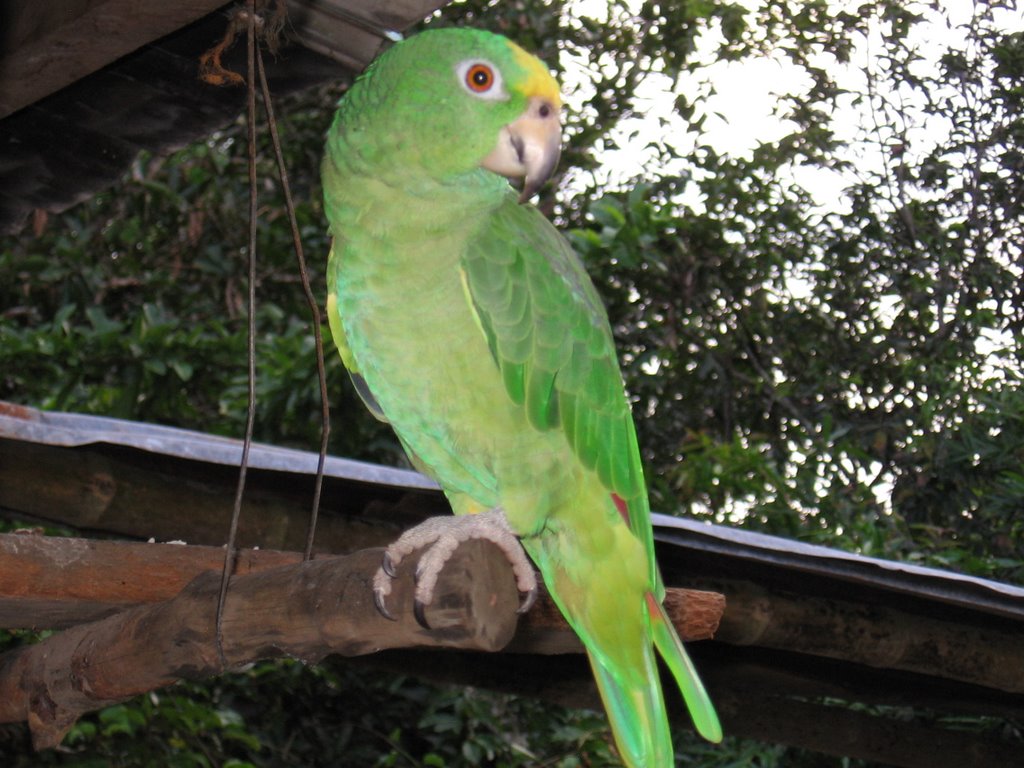
Querida the talking parrot was there to greet me with a loud squawk upon my return from Panama City last week. My host abuelita asked me if I was going to buy a parrot when I move to my own place next month. She is very concerned about my living alone and lejos, even though the house is just around the corner. I have developed a certain attachment to the bird, and will be back to visit and converse with it once the move is made. For now, I´m waiting for the owner of the house to return from his work on a nearby island so he can begin finishing the place. Right now it has no sink, shower, latrina...virtually nada.

I was comforted by the parrot´s greeting after an exhausting week in the city...a nice welcome back to the tranquilo lifestyle in the campo. I made the 14-hour round trip bus ride with intentions of getting a little work done in the office headquarters, and seeing some friends that were in town for a conference. Both of these goals were accomplished, but the change of lifestyle from 9pm bedtime to going out with friends in the American-esqe cuidad left me without much energy for our regional meeting in the mountain town of Boquete. Nonetheless, the meeting went well, and I was encouraged by meeting some of the veteran volunteers. The director of the entire Panama program came to my site the next day, and I may have been deliriously tired. Remembering the day arrives to my mind in snapshots, like a dream, one of which is the parrot singing his greeting to me as I stumbled in the door, forgetting to pay the taxi driver in my excited and tired state. What amazes me as I reflect on this day is that arriving to my host family`s house after almost a week away actually felt like coming home.

Friday, September 29, 2006


It looks so easy, the business of being a kid. What synapses in our brain die as we age? We stop growing, eventually (except our noses, ears and waistlines: the uglier parts), learn and move at a slower pace. The older we get the more pruned our brains become, shedding the "unneccesary" connections. Essentially, what appears to be simplicity in childhood is actually complexity, unrefinement, the happiness of a brain yet unformed but forming by a small world of experience.

Yesterday I spun in circles with my arms out until I got so dizzy I fell down. The second-grade girls next to me fell down a few seconds later, while my head spun in a spun-drunk dizzyness, the nauseous feeling finally fading about an hour later. The girls got up right away, ready to invent some other game involving a tennis ball and a pair of plastic flip-flops while I sat in the grass wondering if I ever truly thought that game was fun and needing a small helping hand to get up. Evidently a few of the nerves connecting my enlarging ears to my brain have died, making the sense of equilibrium harder to acheive after a good spin. If I spin like this every day can I re-learn to not get quite so dizzy?